Sora was OpenAI’s text-to-video generator: a system that turned written descriptions into short, realistic video clips with matching sound. If you are searching for it now, there is one fact to know first. OpenAI shut Sora down in 2026. The app and sora.com closed in April, and the developer API followed in September, so there is currently no way to create a new Sora video. This article explains what the sora ai video generator was, what it could do, where it fell short, and which tools cover the same ground today.

How Sora turned text into video
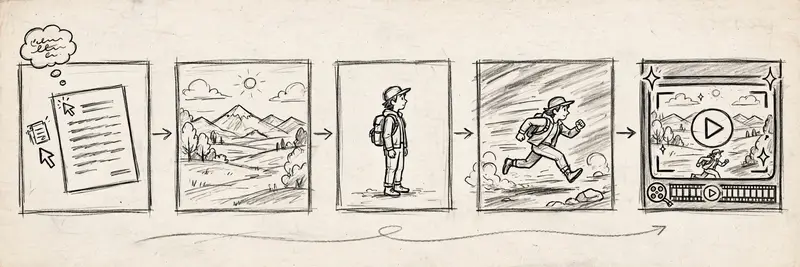
The core idea behind Sora was simple. You typed a sentence describing a scene, and the model generated a short video to match. Early versions also worked from images or existing clips, using them as a starting point for new generations.
Behind the scenes, Sora was a diffusion-based video model trained on large amounts of video footage paired with descriptions. That training taught it how objects move, how light behaves, and how scenes hold together over time.
The first public version appeared as a research preview, later reachable on the web through paid ChatGPT plans. The bigger moment came with Sora 2, launched in late September 2025, which added synchronized audio, dialogue, sound effects, and music, plus a social-style mobile app with a feed, remixing, and a “cameos” feature for inserting yourself into scenes.
Key capabilities while it was live
Sora 2 stood out for a few specific strengths:
- Text-to-video with sound built in. Instead of generating a silent clip and adding audio later, Sora 2 produced dialogue, ambient sound, and music matched to the action.
- Realistic motion. Objects moved, collided, and reacted in believable ways, which became one of the model’s signature qualities.
- Multi-shot sequences. Complex prompts with camera changes or several actions produced clips that felt closer to finished scenes than single static shots.
- Remixing and editing. Users could take an existing clip and change, extend, or restyle it instead of starting from a blank prompt each time.
- Cameos. The social app let people insert their own face into generated scenes.
Developers could also use the model through OpenAI’s API, in a standard and a higher-quality pro variant, so other apps and workflows could build on it.
Limitations that never went away
Sora had real weaknesses. Generated clips were short, longer coherent videos stayed out of reach, and keeping characters or details consistent across scenes was unreliable. The model sometimes misread prompts, dropped details, or produced odd artifacts in hands, faces, and complex physics.
Content rules also shaped what you could make. The system rejected prompts involving real people and copyrighted characters, and misinformation safeguards limited certain realistic scenarios. These guardrails were strict by design, given how convincing the output could look.
Access was limited too. The Sora 2 app never went worldwide. It launched by invitation in the US and Canada, later added Android, and expanded to a handful of Asian countries including Japan, South Korea, Taiwan, Thailand, and Vietnam. Europe, the UK, Australia, and India never got the app, so most of the world could only watch Sora clips on social media.
Availability in late 2026
OpenAI announced the shutdown in March 2026, and it happened in stages. The app and sora.com closed on April 26, 2026, Microsoft removed Sora generation from Microsoft 365 Copilot in the summer, and the API and the Sora 2 models were switched off on September 24, 2026. OpenAI did not name a replacement.
Videos people had already generated and exported remained theirs to keep. But generating new videos through any OpenAI channel is over. Any site offering a “free Sora video generator” now is running a different model under Sora’s name, so treat those claims with care.
One thread stays open. Reporting in October 2026 said OpenAI was in talks to license the technology to a filmmaking startup reportedly co-founded by one of Sora’s lead researchers. Nothing confirmed has come from that yet.
How Sora compared to other video generators
While it was live, Sora’s closest rival was Google’s Veo line. Both made short, realistic clips from text prompts with synchronized audio. Sora was usually rated stronger on physics and motion; Veo on photorealism and dialogue. Neither could make long-form video, and both carried heavy content restrictions. Other options included Runway (editing and speed), Luma (quality and control), and Kling (realistic motion). By late 2026 the field had shifted: Veo continued through Google’s API and tools, while Sora was gone entirely. For context on that rivalry, this Sora 2 vs Veo 3 comparison covers what each model did best.
What to use instead of Sora
If you came here looking for a way to make AI video, pick from the models that are actually running. Google’s Veo models remain available through the Gemini API and consumer tools like Flow. Kling, Seedance, Luma, and Runway all do the same basic job: text or image in, short video out. Platforms that bundle several models in one editor are useful if you want to test more than one without managing separate accounts.
For most casual use, the differences between today’s top models come down to clip length limits, realism, how well they follow detailed prompts, and pricing. Try two or three with the same prompt and compare directly, since no single model wins on every scene. For the timeline, see this rundown of what Sora 2 was and what replaced it.
The bottom line
The sora ai video generator was OpenAI’s attempt to make video creation as easy as typing a sentence, and for a brief period it set the standard the whole industry was judged against. Its synchronized audio, believable motion, and social app made it a cultural moment in 2025. OpenAI closed the app in April 2026 and the API that September, and the technology is currently unavailable.

It is a reminder that AI video tools change fast: a model that dominates one year can be gone the next. Pick tools that are actively maintained, keep your prompts and exported files, and never tie a whole workflow to one model.
For the full story, read this 2026 Sora review covering the shutdown and alternatives and this Gizmodo piece on Sora 2’s limited rollout and closure.