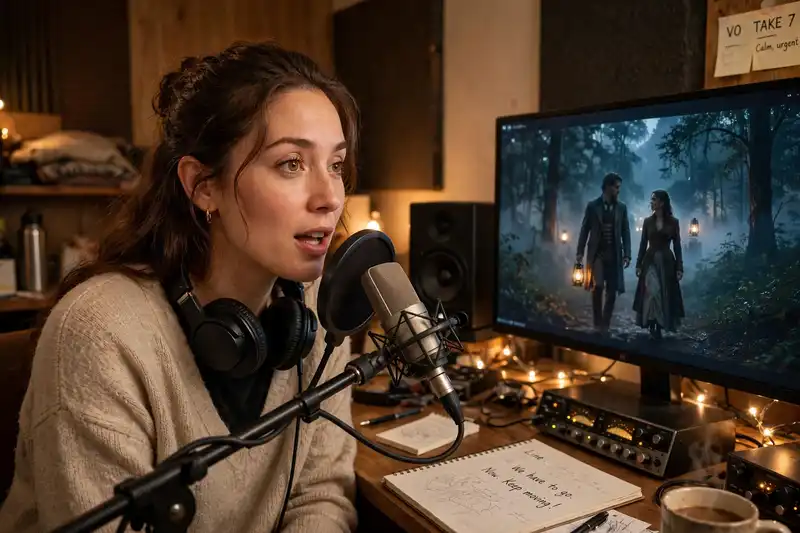
**Dubbing is the process of replacing the original spoken voice in a film, show, or video with a new voice, usually in a different language, so the audience hears the story in their own tongue.**
You have heard it every time a Hollywood film plays on German television with German voices, or a Korean drama reaches viewers in Spanish. The actors stay the same. The voices change. Done well, you forget the swap within minutes.
What dubbing is
It covers any replacement of the original dialogue track. The most common form is language dubbing: a film shot in English gets a French voice track for viewers in France. The same technique covers other jobs: a line recorded badly on set, a child actor’s voice replaced by an adult’s, or an animated character voiced for each market.
The work has two masters: translation and timing. The translated lines must carry the meaning, the jokes, and the tone of the original, and they must fit the mouth movements on screen, or the mismatch pulls the viewer out of the story. A good dub hides both jobs at once. Our Sora AI video generator guide covers the video tools that now sit beside dubbing in a creator’s workflow.
How traditional dubbing works
Traditional dubbing starts with a translator who adapts the script, not just the words. A line that runs long in German and short in English needs rewriting to fit the same shot. The adapter counts syllables and keeps the joke intact where a literal translation would kill it.
Voice actors record next. They watch the scene, listen to the original line through headphones, and speak the new line to match the actor’s mouth. A director calls for another take when the timing slips. The engineer then mixes the new voices with the music and sound effects, which stay untouched. A feature film can take weeks. A television episode takes days.
The countries with the strongest traditions are Germany and France, Italy and Spain, and much of Latin America. In those markets, audiences grew up hearing foreign films in their own language, and a subtitled release can feel like a lesser product. In English-speaking markets, the habit runs the other way: audiences prefer subtitles for foreign films and dubbing mainly for children’s animation.
Dubbing vs subtitling
Dubbing and subtitling solve the same problem in opposite ways. Dubbing replaces the voice, so the viewer watches the picture without reading. Subtitling keeps the voice and adds text at the bottom of the screen, so the viewer reads while watching. Each has a loyal audience, and the argument between them never ends.
It suits viewers who want to watch the picture: children, people watching while cooking, and audiences in countries where it is the norm. It costs more, because it needs translators, actors, and a studio. Subtitling suits viewers who want the original performance: the actor’s real voice, with its pauses and cracks. It costs less, and it preserves the acting. The choice usually follows the market, not the quality of either method.
Streaming changed the balance. A show that once reached one country now reaches a hundred on launch day, and platforms order dubs in dozens of languages at once. The volume of this work has grown, and so has the pressure to do it faster. That pressure is where AI entered the picture.
How AI changed dubbing
AI dubbing follows the same stages as traditional dubbing, with machines doing the repetitive parts. The tool transcribes the original dialogue, translates it, generates new speech in a cloned voice, and adjusts the lip movements to match. ElevenLabs dubbing leads on voice quality for audio, while HeyGen’s video translation leads on lip-synced video in more than 175 languages.
The speed is the draw. A creator can dub a ten-minute video into five languages in an afternoon, a job that once needed a studio booking. The cost is lower too, since most tools charge per minute of audio. The quality gap is narrowing, but AI voices still struggle with shouting, whispering, and comedy timing.
AI also changed who dubs. A small YouTuber can now reach viewers in Brazil and Japan without a budget. A company can train staff in twelve countries from one recording. The work that once belonged to studios now belongs to anyone with a browser. TechCrunch’s AI section tracks the tools as they improve, and Google’s blog covers the company’s own work on translation and voice.

What makes a good dub
A good dub starts with a good translation. The adapter must know both languages and both cultures, because a joke that works in English may need a new joke in German. The voice casting matters as much as the words: a deep voice on a young actor breaks the illusion before the first line ends. Voices that sit too loud over the music sound like a lecture, not a film.
The test is simple. Watch five minutes with the sound on and the subtitles off. If you forget you are hearing a dub, it worked. AI dubs pass that test more often than they did two years ago, and the gap keeps closing.
How to choose between dubbing and subtitles
Choose dubbing when the audience watches rather than reads: children’s content, casual viewing, and markets where it is the norm. Choose subtitles when the original performance matters: drama, documentaries, and arthouse films. Choose both when the platform allows it, and let the viewer decide.
For creators, the math is simple. A dubbed video reaches viewers who would never read subtitles. A subtitled video reaches viewers who want the original voice. Doing both costs more than doing one, and the return depends on where your audience lives. Our WhatsApp Channels guide covers another way to reach audiences in other languages, the best AI tools comparison lists the dubbing tools, the Google AI Mode guide covers AI answers in search, and the ChatGPT new features guide tracks the leading chatbot.

Frequently asked questions about dubbing
What is dubbing?
Dubbing is the replacement of the original spoken voice in a film, show, or video with a new voice, usually in a different language, so the audience hears the story in their own tongue.
What is the difference between dubbing and voiceover?
Dubbing replaces the original dialogue and matches the lip movements. A voiceover adds a new voice on top for narration, without matching the lips.
Which countries dub foreign films?
Germany, France, Italy, Spain, and much of Latin America have strong dubbing traditions. English-speaking markets usually prefer subtitles for foreign films.
Is AI dubbing as good as human work?
AI dubbing is close for plain narration and simple dialogue. Human actors still lead on emotion, comedy timing, and shouting or whispering.
How much does it cost?
Traditional studio work costs far more than AI dubbing, which usually charges per minute of audio. The price rises with the number of languages.
Can I dub my own videos?
Yes, you can. Browser tools can dub a video into another language in minutes, with voice cloning that keeps your voice. Review the result with a native speaker before you publish.