Conversational AI apps are apps that let you talk to an AI in plain language, and get back answers, drafts, plans, code and research, instead of a list of links.
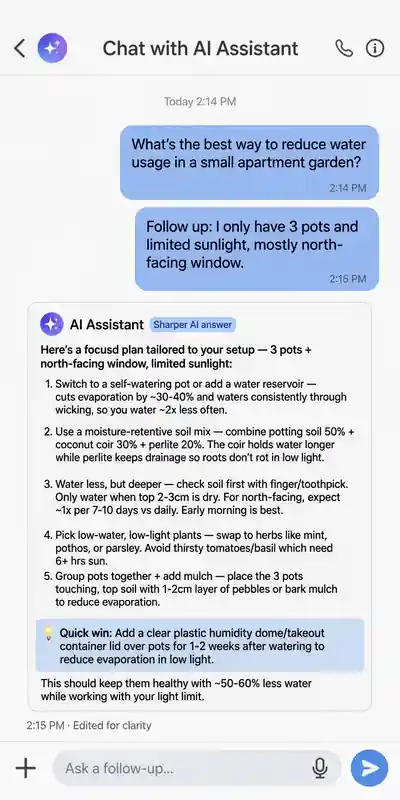
You type or speak a question, and the app replies in conversation. You ask a follow up, it remembers the thread, and the answer gets sharper. That loop is the whole product: a chat that does work, not a search box that returns pages.
The field is crowded now. ChatGPT, Claude, Gemini, Copilot, Perplexity, Grok, Meta AI and Poe all do conversational AI, and each one is built for a different job. Picking the right app is less about which model is smartest, and more about where you already work, what you write, and whether you need sources you can check.
What a conversational AI app actually does
At the core, every conversational app runs a large language model. The model predicts the next words from patterns in its training data, and the app wraps that prediction in a chat interface with memory, tools and a way to upload files. Memory is what makes it conversational: the app carries the thread across messages, so a follow up like “make it shorter” makes sense without repeating the request.
The main apps compared
ChatGPT is the safest single paid subscription for everyday chat, images, voice and research in one app. It handles drafting, brainstorming, coding help, image generation and voice conversation, and Plus adds higher limits plus Deep Research runs each month. A free tier exists, Go costs $8 a month, and Plus costs $20. Our ChatGPT new features guide covers the features behind each tier.
Claude suits long writing and document work, with a careful tone and strong handling of large files. Users can upload reports, contracts or manuscripts and ask for summaries, edits or analysis that respects the source text. Claude Pro costs $20 a month, and paid plans still carry usage caps in five hour windows. The Claude vs ChatGPT comparison puts the two head to head.
Gemini suits people who live in Gmail, Docs and Drive, since Gemini works inside those apps on the Google AI Pro plan. Its free tier is the most generous from a major lab, with voice, Deep Research, NotebookLM and image generation included. A comparison of eight chat apps ranks ChatGPT first for all round use, Claude for writing, and Gemini for Google Workspace work.
Perplexity is the best pick when answers need sources you can open and check, rather than a plain chat reply. Copilot is the free pick for Windows and Microsoft 365 users. Meta AI is the casual option already sitting in WhatsApp and Instagram, and it is entirely free. Poe lets you try many models in one app, and Character.AI lets you chat with fictional characters, though that platform filed for bankruptcy in October 2026. The AI Rankings chatbot guide lists the same field with current prices. A nine assistant ranking scores the main chatbots on documented features.
How to pick the right one
Next, check the free tier. Gemini gives the most away for free, ChatGPT gives a solid free tier with ads on Free and Go, and Meta AI costs nothing at all. Pay only when you hit a limit that matters: higher usage, longer documents, or Deep Research runs. A comparison of eight assistants lists the free and paid tiers side by side.
Finally, test the voice. A conversational app lives or dies on how it talks, and the only way to know is to use it for a week on real work. Ask it to plan a trip, draft a difficult email, and summarise a long document. The app that handles all three without a fight is the one to pay for. The Gemini vs ChatGPT comparison and the best AI tools comparison both help with that test.

What conversational AI apps cannot do well
They invent facts. Every conversational app can state a wrong fact with total confidence, and the only safety net is a source you can open. Perplexity links its claims, and the others are catching up, but no app is a substitute for checking an important fact yourself. Never rely on a chatbot for medical, legal or financial advice without a professional check.
Privacy and ads: read before you chat
Chats are data. Most apps store your conversations, some use them to train models unless you opt out, and some show ads on free and low cost plans. OpenAI shows ads on the Free and Go tiers, and ChatGPT Go at $8 a month may include them. Check the privacy settings in the app you choose, and turn off training use where the option exists.
Share nothing you would not want read back. No passwords, no account numbers, no private documents you cannot afford to lose. Use the app for work you can check, and keep sensitive material out of the chat entirely. Our guide to keeping a website safe for users covers the same hygiene for the wider web.

Frequently asked questions about conversational AI apps
What is the best conversational AI app?
ChatGPT is the best all round pick for most people, with chat, images, voice and research in one app. Claude is better for long writing, Gemini is better for Google Workspace users, and Perplexity is better when sources matter.
Are conversational AI apps free?
Most offer a free tier. Gemini has the most generous free tier, Meta AI is entirely free, and ChatGPT offers a free plan with ads. Paid plans start at about $8 a month for ChatGPT Go and $20 for ChatGPT Plus and Claude Pro.
What is the difference between a chatbot and a conversational AI app?
A chatbot is any program that chats. A conversational AI app is a chatbot built on a large language model, with memory, tools and file uploads, so it can hold a conversation and do work across many turns.
Can conversational AI apps replace Google search?
They answer in conversation and invent facts, while search returns pages you can check. Use the app for drafting, planning and brainstorming, and use search when the fact itself matters.
Do conversational AI apps remember my chats?
Yes, within limits. Most carry memory across chats on paid plans, and all remember the current thread. Memory can be turned off or deleted in settings, and it is limited by the context window.
Which conversational AI app is best for research?
Perplexity is the best research pick, since it searches the web and links every claim to a source. ChatGPT Plus adds Deep Research runs, and Gemini includes Deep Research on its free tier.