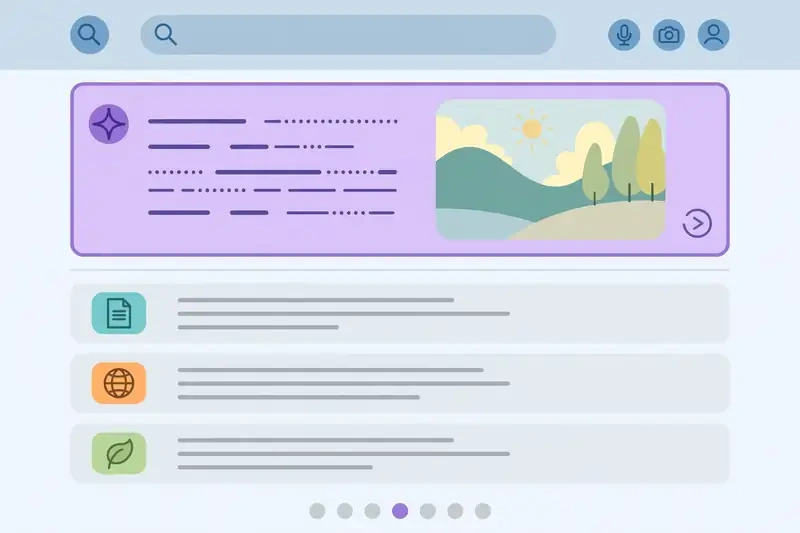
Google AI Overviews are AI-generated summaries that appear at the top of Google search results, answering the query directly so the reader may not need to click through to a website. When people talk about a “Google AI Overview update,” they usually mean one of three things: Google switched the underlying model to a newer version, Google changed the layout or link design of the summaries, or Google expanded the feature to more countries and languages. Each kind of update changes what searchers see and how much traffic flows to the sites being cited.
How AI Overviews work
An AI Overview does not answer from a language model’s memory. When you type a query, Google runs several related searches behind the scenes, a technique Google calls query fan-out. It pulls passages from pages already in its live web index, then a customized Gemini model reads those passages, extracts the relevant facts, and writes a fresh summary with clickable links attached to the claims.
This is why only indexed pages can appear. If Google has not crawled your page, or your page is not eligible to show in regular search results, it cannot be used in an AI Overview either. Google’s own documentation says there are no extra technical requirements beyond that: no special schema, no new meta tags, and no separate submission process. Normal SEO practice is what applies.
AI Overviews do not trigger on every query. Google shows one only where its systems decide a summary adds something beyond the classic list of links. Simple navigational searches rarely get one. Longer informational questions get them more often. The feature launched in May 2024 as the successor to the Search Generative Experience test and now runs in more than 200 countries and territories in close to 100 languages.
How they differ from featured snippets
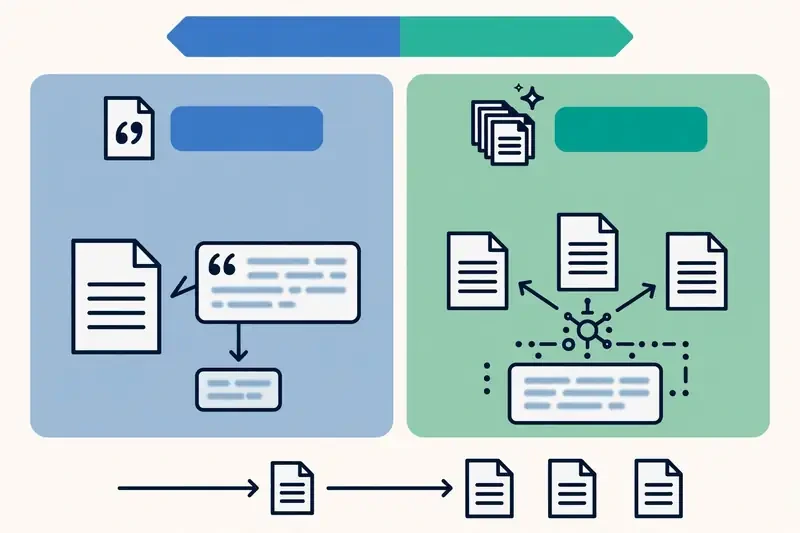
A featured snippet lifts an exact piece of text from one webpage and shows it above the results. An AI Overview does the opposite job: it writes a brand-new answer built from several sources at once. A Pew Research Center analysis of 68,879 US searches found that 18 percent produced an AI summary, and 88 percent of those summaries cited three or more sources.
That difference matters for clicks. The same Pew study found that users clicked a regular result on only 8 percent of visits that showed an AI summary, compared with 15 percent of visits without one. A snippet sends you to the quoted page. An overview tries to answer the question right there, with links as backup. More on how Google handles the citations can be found in Google’s official documentation for AI Overviews and your website.
Recent updates to AI Overviews
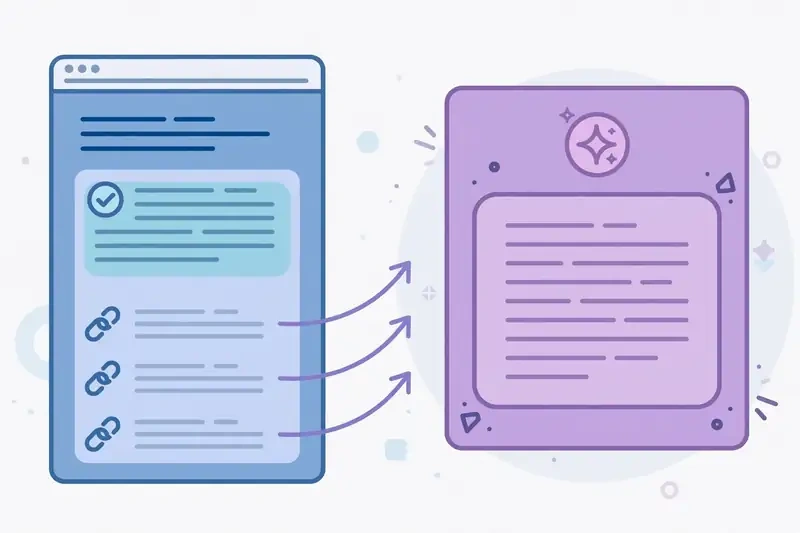
Google keeps changing the feature, and the changes in 2026 have mostly been about links. On October 15, 2026, Hema Budaraju, Google’s vice president of product management for Search, announced that inline links inside AI Overviews and AI Mode would appear higher in responses and more often. The same announcement added a test section that highlights the one or two official pages that best answer a task, expanded news carousels to more countries and languages, and refreshed the “Dive Deeper” links at the end of answers with image thumbnails to make them easier to spot.
The update also made creator and publisher names clickable in video results, so readers can see more work from the same source. Google said more than 400 publications are now part of its News AI pilot licensing program, where it pays publishers for content used to develop new AI features.
Earlier in the year, Google connected AI Overviews more tightly to AI Mode. Clicking “Show more” on an expanded overview now opens an AI Mode conversation, letting the searcher ask follow-up questions in a chat interface that keeps the context of the original query. At Google I/O in May 2026, Sundar Pichai said AI Overviews had passed 2.5 billion monthly users, which shows how central the feature has become to search.
One thing has not changed through all of this: measurement. Google’s Generative AI performance report in Search Console, which opened to every site on August 31, 2026, reports impressions from AI Overviews and AI Mode but no click data. Site owners can see how often their pages appeared, grouped by page, country, and date, but they cannot see how many people clicked. This remains a genuine frustration for publishers, and it is worth knowing before you read any claim about how much traffic an update “gives back.”
How site owners get cited
There is no trick to appearing in an AI Overview. Google builds the summaries from the same pages it ranks, so the work overlaps heavily with ordinary SEO. Pages that earn citations tend to share a few traits.
First, they answer the question directly and early. An AI Overview extracts discrete facts, so a clear definition or direct answer near the top of the page is easier to use than one buried under paragraphs of buildup.
Second, they are structured for extraction. Descriptive headings, short paragraphs, and lists help the model find and quote the right piece of content. Third-party analyses of citations keep finding that list-style content, such as step-by-step guides and ranked lists, shows up disproportionately often.
Third, they are trustworthy. Google weights sources it considers authoritative, which is where E-E-A-T comes in: real experience with the topic, demonstrable expertise, a credible site, and content that is accurate and current. YMYL topics like health and finance get stricter treatment, and Google does not place ads inside AI Overviews in those sensitive categories.
Finally, the basics still decide everything. The page must be crawlable, indexed, fast, and eligible for snippets. Google has confirmed it does not read llms.txt files for indexing or AI Overviews, so that community proposal has no effect on whether your content gets used. Google’s Search help center is the place to check how the feature behaves for end users, while industry trackers like the Search Engine Roundtable document each change as it rolls out.
What updates mean in practice
For readers, updates to AI Overviews mostly mean better or worse answers and more or fewer visible links. For site owners, the practical effect is simpler than the headlines suggest. Your page either gets used as a source or it does not, and the lever you control is the same one you always had: publish content that answers the question better than anyone else’s, structure it so machines can parse it, and keep it accurate as the topic changes.
One concrete step is worth doing now. Open the Generative AI performance report in Search Console and check which of your pages are already getting impressions from AI Overviews. Those pages are working as sources, and strengthening them with clearer answers and fresher facts is the most direct way to benefit from the next update, whenever it arrives. Google’s announcements about the program, including the October link redesign, are posted on Google’s official blog.