An AI agent is software that works toward a goal on its own, perceiving its environment, reasoning about what to do next, and taking actions through tools until the job is done or it gets stuck.
That last part is the whole point. A chatbot waits for your next message. An agent keeps going until the goal is met. The model alone is not the agent. The agent is the model with tools and memory around it, in a loop that checks its own work.
What an AI agent is
IBM describes agentic AI as a system that accomplishes a specific goal with limited supervision. IBM explains how agentic AI perceives, reasons, decides, and executes. Put simply, an agent takes a goal, looks around, decides, acts, and looks again. Perception reads the environment, reasoning turns input into a plan, and action touches the world through API calls and file edits.
Memory keeps a long task coherent: the conversation so far, plus notes the agent keeps for itself. Tool use is the line between talking and doing. A model with no tools can only produce text. Anthropic boiled the idea down to a phrase: LLMs autonomously using tools in a loop. The what is LLM guide explains the models that usually supply the reasoning.

How an AI agent works
Most agents run the same loop. The agent reads the current state. It reasons about the goal. It picks one action and runs it through a tool. Then it reads the result and decides whether to keep going or stop and ask you. The hard part is spotting a wrong result before it compounds.
Planning sits above the loop: harder tasks get broken into subtasks, with the plan revised when a step fails. Retrieval feeds the loop with fresh facts from documents, databases, and search results. The what is RAG guide explains that retrieval step. OpenAI’s agent guide recommends rating tools by risk, with approval before hard-to-undo actions.

How agents differ from chatbots and automation
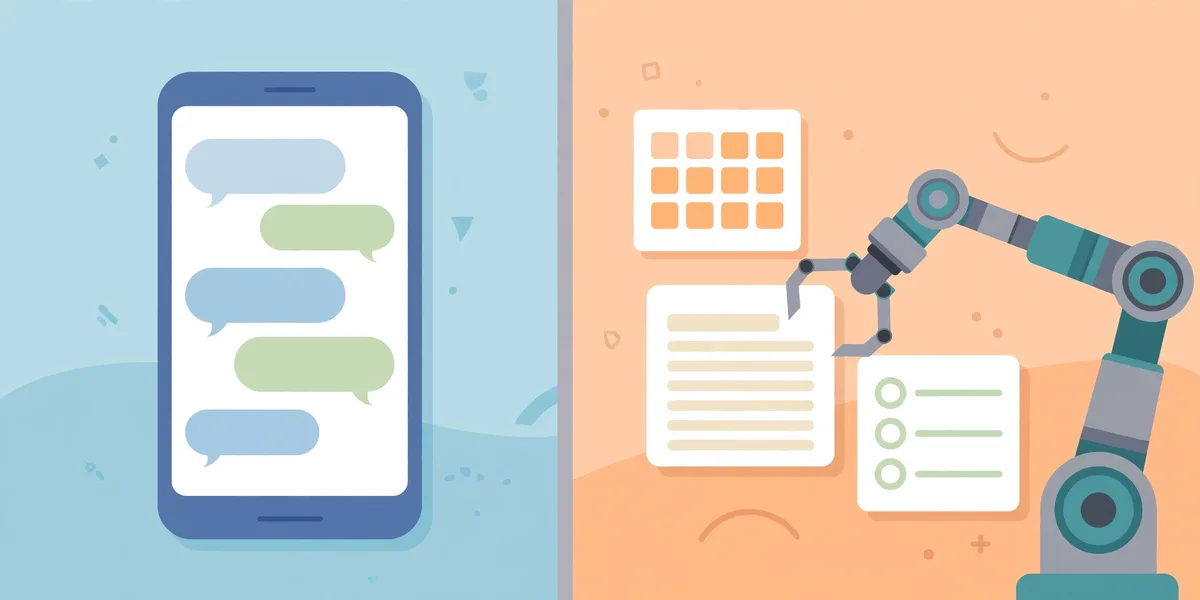
The confusion is understandable. Every product now calls itself an agent, even ones that only answer questions. The test is who decides the next step. In a chatbot, you do. In fixed automation, the rules do: the same trigger runs the same steps every time. In an agent, the model decides within limits you set.
Anthropic draws the same line in its engineering guide. Anthropic defines workflows and agents by who directs the process. The guide’s advice: start simple, and add agency only when simpler approaches fall short, because agentic systems trade latency and cost for performance. A chatbot answers questions about Lisbon; an agent plans the weekend, checking flights, comparing prices, and drafting an itinerary. The ChatGPT Search guide answers questions from the live web, but answering is still not acting.
ReAct and the planning loops behind agents
Most agents today follow a pattern from a paper. ReAct, from Princeton and Google researchers in 2022, interleaves reasoning traces with actions: the model writes a thought, takes an action, reads the observation, and thinks again. The ReAct paper interleaves reasoning traces and actions in one loop. ReAct reduced hallucination on question answering tasks by checking a Wikipedia API mid-task, and beat imitation and reinforcement learning methods by 34 and 10 percentage points on two interactive benchmarks.
Planning loops build on that idea: plan, execute, check, replan. Here is the complication. Later research found ReAct brittle: small changes to the examples shifted results, and much of the gain came from example-task similarity, not the interleaved reasoning. Arizona State University researchers reported that performance was minimally influenced by the interleaving or the reasoning traces. The loop still works in practice, but the neat story is shakier than the marketing suggests.

Real AI agents you can use today
ChatGPT Agent runs on its own virtual computer. It browses with a visual browser, reads pages fast as text, runs code in a terminal, and reaches your apps through connectors. The ChatGPT Agent guide covers setup and limits. It pauses to ask before sensitive actions such as purchases.
Coding is where agents feel most grown up. Devin, from Cognition, takes a whole ticket, writes and tests code in its own environment, and opens a pull request for review. At launch it resolved 13.86% of real GitHub issues in the SWE-bench test, against a previous best of 1.96%. Claude Code lives in your terminal: it reads your codebase, edits files, runs commands and tests, with a CLAUDE.md file carrying project context. Cursor puts agent features inside a code editor.

Where AI agents fall short
Agents fail in ways chatbots do not, because their mistakes take effect. A wrong booking or a deleted file is harder to ignore. Errors compound: one bad step feeds the next, and the agent wanders far from the goal before anyone notices. Cost is the quiet limit: every step is another model call. Loops without limits can run away entirely: OWASP lists denial of wallet attacks among agent risks.
Security is the sharpest limit, because an agent reads untrusted text all day, and hidden instructions in a web page or email can try to redirect it, a trick called prompt injection. OWASP lists prompt injection, tool abuse, data exfiltration, and memory poisoning among agent risks, and recommends least privilege access and human approval for risky actions. Treat agent output that moves money or changes records as a draft until a person checks it. The best AI tools compared roundup puts agent products beside simpler tools: most jobs need the simpler tool.

Frequently asked questions about AI agents
What is an AI agent in simple terms?
Software that takes a goal, decides the steps itself, uses tools to carry them out, and checks its results. You describe the outcome. The agent figures out the route.
Is ChatGPT an AI agent?
Ordinary ChatGPT chat is not an agent: it answers, and you decide what happens next. ChatGPT Agent, the mode that browses, runs code, and acts in connected apps, is.
What is the difference between an AI agent and a chatbot?
A chatbot answers questions in conversation. An agent pursues a goal by choosing tools and taking actions outside the chat, such as booking a flight or editing a file. Automation runs fixed steps; an agent chooses its steps as it goes.
Do AI agents need a large language model?
No. The agent idea is older than large language models, and classic textbooks describe reflex, model-based, goal-based, utility-based, and learning agents built from rules and search. Modern agents usually use a language model as the reasoning engine.
Are AI agents safe to use?
They are safe enough for low stakes work with narrow permissions and human approval. They are not safe unsupervised with broad access to your email and payment accounts, because prompt injection and compounding errors can turn a small mistake into a real one. Start narrow.
Can I build an AI agent without coding?
Yes, for simple workflows. Visual builders let you connect a model to tools with drag and drop steps. Anything that touches real data or takes real actions still needs careful setup and testing, with permission limits in place.