AlphaFold AI is a DeepMind system that predicts the three-dimensional shape of a protein from its amino acid sequence, with accuracy close to lab experiments in most cases.
Proteins do most of the work inside cells, and each one works only when it folds into the right shape. Working out that shape from the chain alone took science more than 50 years. AlphaFold returns a predicted 3D structure from a sequence, plus a confidence score for each part.
What AlphaFold is
A protein is a long string built from 20 different amino acids. The string folds into a compact 3D shape, and that shape decides what the protein does. Since the 1970s, researchers had tried to predict shapes from sequences, but the problem stayed stubbornly hard. Google DeepMind traces the project from a small post-AlphaGo team to the breakthrough.
AlphaFold 2 arrived in 2020. Demis Hassabis and John Jumper presented the system, which predicted virtually all the 200 million known proteins.
Every prediction carries a per-residue confidence score called pLDDT. High scores mean the model is sure. Low scores warn you not to lean on that region. AlphaFold is a specialist tool for one scientific job, one of many in the best AI tools compared.

How AlphaFold predicts a protein shape
The input is the amino acid sequence. AlphaFold also pulls in a multiple sequence alignment, the same protein family lined up across many species. Positions that change together across species often sit close together in the folded shape.
Repeated blocks called Evoformer process the alignment and a map of residue pairs together, using attention to link the two views. A structure module then turns that picture into 3D coordinates, and the network feeds its output back through itself to refine it, a step the team calls recycling. Attention is the same mechanism at the center of language models; see the what is an LLM guide.
Training data came from the Protein Data Bank, the archive of solved structures. Only around 100,000 unique proteins had solved structures, against billions of known sequences. AlphaFold learned the patterns from that small solved set, then applied them to the rest.

AlphaFold 2, CASP14 and the Nobel Prize
CASP is the field’s blind test: groups predict structures solved in labs but not yet public, and assessors score the guesses. In the 2020 round, CASP14, AlphaFold’s median backbone accuracy was 0.96 angstroms, against 2.8 for the next best method. A carbon atom is about 1.4 angstroms wide, so the typical error sat inside the width of a single atom.
The Nature paper reports accuracy competitive with experimental structures in a majority of cases. The method appeared in July 2021 with its code, and the paper has since been cited more than 40,000 times.
The Nobel Prize followed in October 2024. One half went to David Baker for computational protein design. The other half went jointly to Demis Hassabis and John Jumper for protein structure prediction. The Nobel announcement keeps those two jobs apart. Baker designs proteins that do not exist in nature. Hassabis and Jumper predict the shapes of proteins that do.

AlphaFold 3 goes beyond single proteins
AlphaFold 2 handled single protein chains. It did not model DNA, RNA, or the small molecules that become drugs. AlphaFold 3, introduced in May 2024 by Google DeepMind and Isomorphic Labs, takes on the whole complex at once: proteins with DNA, RNA, ligands, ions, and chemical modifications.
The architecture pairs an improved Evoformer with a diffusion network, the model family behind AI image generators. It starts from a cloud of atoms and refines it into a final structure. For protein interactions with other molecule types, Google DeepMind reports at least a 50% improvement over existing methods. On the PoseBusters benchmark for drug-like binding, it beat the best traditional methods by 50% without needing any structural input.
Access runs through AlphaFold Server, free for non-commercial research. Isomorphic Labs applies it to drug design with pharmaceutical partners.

The database and what scientists do with it
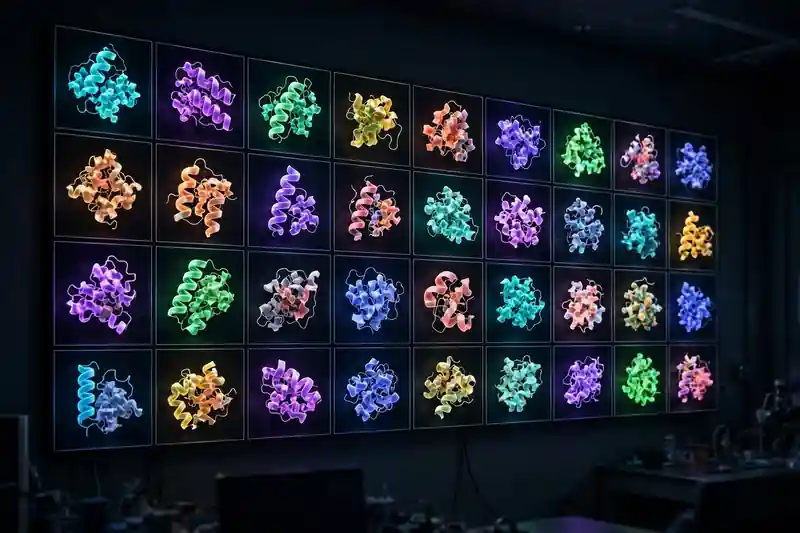
In July 2021, DeepMind and EMBL-EBI opened the AlphaFold Protein Structure Database with over 350,000 structures, covering the human proteome and 20 other organisms. A year later it grew to over 200 million structures. The database homepage now lists over 260 million predictions, and the latest release holds over 200 million entries covering UniProt. Data carries a CC-BY-4.0 licence, open to academic and commercial use.
More than 3 million researchers in over 190 countries use AlphaFold. The Nobel announcement names antibiotic resistance and plastic-decomposing enzymes among the uses. Looking a protein up before running a new prediction follows the same look-it-up-first pattern as retrieval augmented generation, and labs chain prediction into automated workflows; see the AI agent guide.
For drug discovery, a target protein’s shape shows where a drug molecule might fit before lab work starts. A predicted shape is a starting point, not a finished drug. Binding, safety, and effect in the body still need lab and clinical work.
What AlphaFold still gets wrong
A predicted structure is one frozen shape. Real proteins move. They bend, open, and close as they work. AlphaFold returns a single static snapshot. EMBL-EBI notes that AlphaFold 3 predicts the closed form of certain E3 ubiquitin ligases whether or not a ligand is bound, while the free protein sits open.
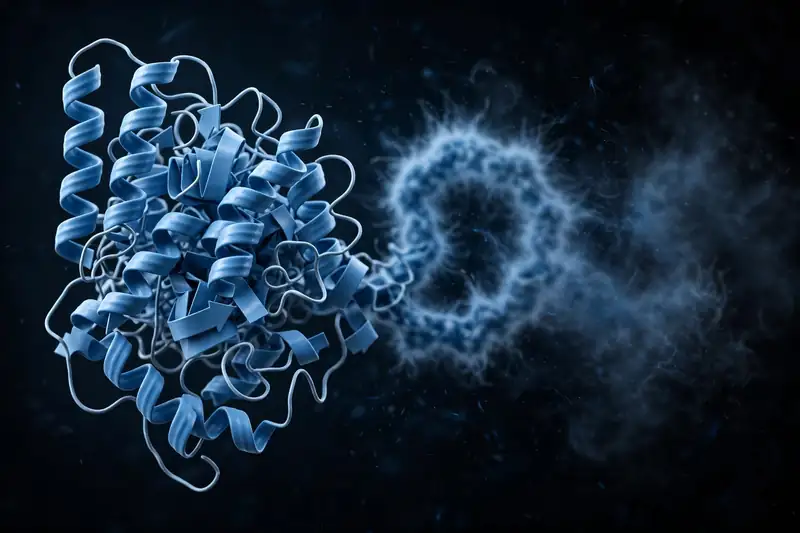
Disordered regions are the other weak spot. Some protein stretches never settle into one shape. AlphaFold 2 marks these regions with low confidence scores. AlphaFold 3 can do worse: as a generative model, it sometimes invents tidy order in disordered regions, showing neat helices where nothing stable exists. That invented order is a form of AI hallucination, though the invented parts usually score well below 50.
Accuracy also drops for orphan proteins, single point mutations, and highly variable molecules such as antibodies. On PoseBusters, AlphaFold 3 breaks chirality, the handedness of small molecules, in 4.4% of cases. Read the confidence scores, and treat each prediction as a hypothesis the lab still has to check.
Frequently asked questions about AlphaFold AI
What is AlphaFold AI?
AlphaFold AI is a DeepMind system that predicts the 3D shape of a protein from its amino acid sequence. It reports a confidence score for each part.
Is AlphaFold free to use?
The AlphaFold Database is free, under a CC-BY-4.0 licence for academic and commercial work. AlphaFold Server gives free access to AlphaFold 3 for non-commercial research.
How accurate is AlphaFold?
At CASP14, AlphaFold 2 reached a median backbone accuracy of 0.96 angstroms, close to experimental methods. Check the pLDDT score before trusting any single region.
What is the difference between AlphaFold 2 and AlphaFold 3?
AlphaFold 2 predicts single protein structures. AlphaFold 3 predicts whole complexes, including proteins with DNA, RNA, ligands, and ions.
Is AlphaFold the same as Gemini?
No. AlphaFold is a specialist model for molecular structures from Google DeepMind. Gemini is Google’s general purpose AI model, covered in the Gemini 3 guide.
Can AlphaFold replace lab experiments?
No. Predictions are models, not measurements. Labs still confirm structures, test how proteins move, and check drug candidates.