
AGI, short for artificial general intelligence, is a hypothetical AI system that could match people across most intellectual work and carry what it learns into tasks it has never seen.
The question of what is AGI is practical: how broad must a system be, and how good, before the label fits? IBM defines AGI as a hypothetical stage of machine learning in which a system can match or exceed human cognitive abilities across any task.
What is AGI, exactly
A person who writes essays can also learn card games and fix wobbly tables. That transfer is the heart of the idea. AGI would learn a skill in one setting and use it in another without being rebuilt for each new job.
Today’s chatbots look broad because they answer questions on many topics, as the GPT-4o guide shows. The look is misleading. They still fail at long projects that need planning and memory.
Generality also needs independence. An AGI system would take a vague goal, break it into steps, and keep going when the first plan fails. Current tools wait for detailed prompts and stop at the first error. Agent-style tools close part of the gap, as the ChatGPT Agent guide shows, but they still work inside narrow limits.

Why no one agrees on a definition
The term itself is young. AI researcher Ben Goertzel popularized “artificial general intelligence” in 2007, at the suggestion of DeepMind cofounder Shane Legg, according to IBM. Researchers have argued ever since: “intelligence” has no single formal definition either.
OpenAI uses an economic test. Its Charter defines AGI as “highly autonomous systems that outperform humans at most economically valuable work.” That wording counts jobs and output. It leaves out how a system thinks. Google DeepMind researchers took a different route in a paper first posted in November 2023, grading systems on performance and breadth at once.
This disagreement decides what counts as evidence: under an economic definition, replacing paid work is the test, while under a breadth-and-performance definition, the test is a set of tasks at a set percentile of skilled adults.

The levels of AGI, from emerging to superhuman
Google DeepMind researchers replaced one finish line with a ladder in the Levels of AGI paper, first posted in November 2023. Meredith Ringel Morris and seven co-authors graded systems from Level 0, no AI, to Level 5, superhuman, for narrow and general systems. A chess engine can be superhuman and narrow at the same time.
The paper’s own ratings are the complicating fact. The authors placed ChatGPT, Bard, Llama 2, and Gemini at Level 1, “emerging AGI,” meaning equal to or somewhat better than an unskilled human.
Level 2, “competent AGI,” means reaching at least the 50th percentile of skilled adults. The authors marked Levels 2 to 5 not yet achieved. Under this framework, AGI has both started and barely begun.

When experts think AGI will arrive
Lab leaders give the shortest timelines. Anthropic, the company behind the model covered in the Claude Sonnet guide, said in March 2025 that it expected powerful AI systems within about two years, able to match Nobel Prize winners across most disciplines and do digital work on their own. Dario Amodei, Anthropic’s CEO, sketched the same idea in his October 2024 essay “Machines of Loving Grace,” and in a later essay put such systems as little as one to two years away.
Demis Hassabis, who leads Google DeepMind, has said AGI is probably a few years away. Sam Altman, who leads OpenAI, wrote in a June 2025 essay that “the takeoff has started.” Both men run labs racing to build the thing they are predicting.
The broad research community is far less sure. A survey of 2,778 AI researchers, published in January 2024 by Katja Grace and colleagues, put the chance of unaided machines outperforming humans in every task at 10% by 2027 and 50% by 2047. That median moved 13 years earlier than the same survey a year before, when it was 2060. Treat any single date as a bet, not a measurement.

How benchmarks try to measure AGI
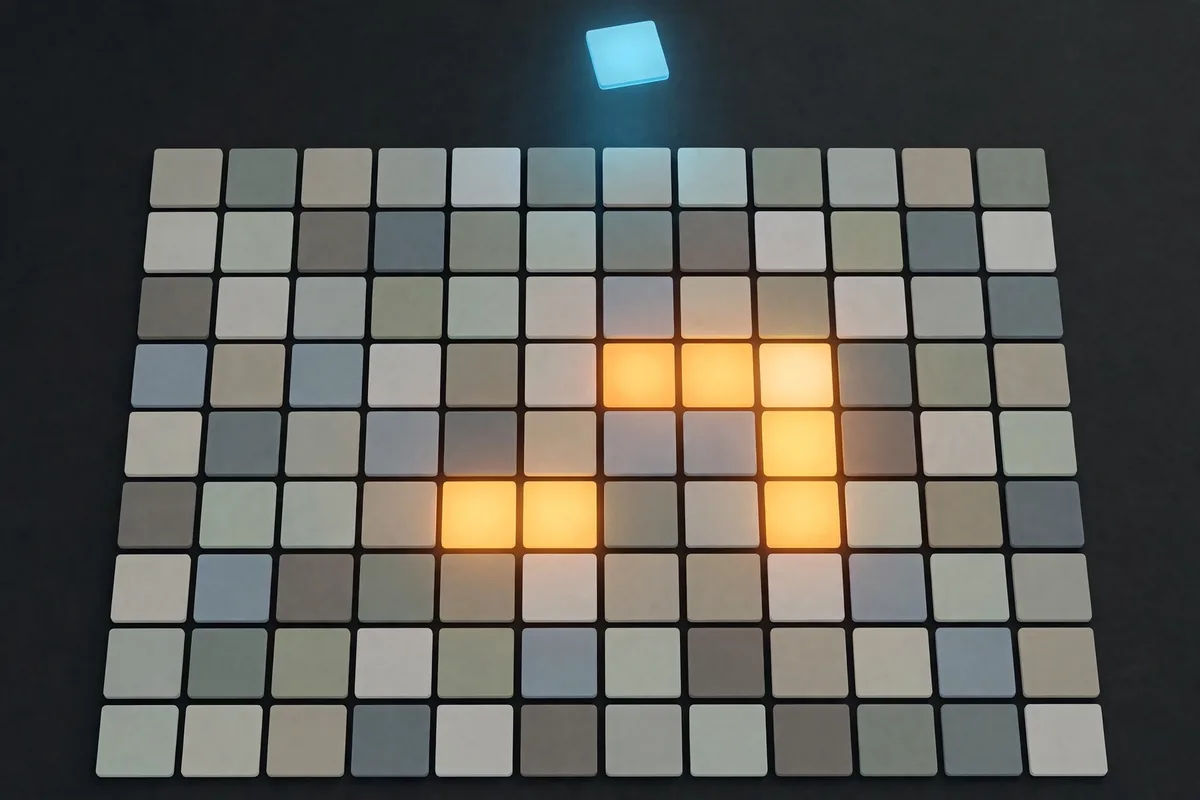
The best known test is ARC-AGI, the Abstraction and Reasoning Corpus. Francois Chollet introduced it in 2019 in his paper “On the Measure of Intelligence.” Each task shows grid puzzles following a hidden rule, then asks the solver to apply the rule to a new grid. ARC-AGI-1 holds 800 tasks, and it stayed unsolved by AI systems until late 2024.
Its harder successor, ARC-AGI-2, now does the heavy lifting, and the ARC Prize team wrote after its 2025 competition that the grand prize remained unclaimed and AGI had not arrived. The top verified commercial model scored 37.6% on ARC-AGI-2, and the top refinement solution, built on the model covered in the Gemini 3 guide, reached 54%. Chollet’s test: “You’ll know AGI is here when the exercise of creating tasks that are easy for regular humans but hard for AI becomes simply impossible.”
SWE-bench tests fixing real software bugs. A model gets a GitHub issue and a codebase, then must produce a patch that passes the project’s own tests. Both tests face a contamination problem: when test tasks leak into training data, a model can pass by recall instead of reasoning. A benchmark score is evidence about that benchmark.
AGI vs superintelligence: what comes after
Superintelligence, or ASI, is the step past AGI. Nick Bostrom defined it in his 2014 book “Superintelligence” as “any intellect that greatly exceeds the cognitive performance of humans in virtually all domains of interest.” AGI matches people, while ASI would beat the best people, everywhere, all at once. AGI does not mean consciousness.
Judge tools by what they do on your own work. The best AI tools compared lines today’s narrow tools up side by side, and the free AI tools for students roundup lists options costing nothing to try. The day a system earns the label, the argument will be about which definition it met.

Frequently asked questions about AGI
What is AGI in simple terms?
AGI is a hypothetical AI system that could do most intellectual work at a human level and apply what it learns to new tasks. No system has met that bar.
Is ChatGPT AGI?
No. IBM says current large language models are not considered AGI. The DeepMind levels paper rated ChatGPT at Level 1, emerging AGI, four levels below superhuman.
What is the difference between AGI and narrow AI?
Narrow AI does one job or a small set of jobs, sometimes better than people. AGI would handle most intellectual jobs at a human level and transfer skills between them.
When will AGI arrive?
Nobody knows. Anthropic expected powerful AI within about two years of March 2025, while a survey of 2,778 researchers put even odds at 2047.
What is AGI vs superintelligence?
AGI would match people across most intellectual work. Superintelligence would beat the best people in nearly every field. It is a hypothesis about what could come after AGI.
How will we know when AGI arrives?
There is no single agreed test. Benchmarks such as ARC-AGI and SWE-bench track reasoning and coding, but scores can reflect memorized training data.